 Hotels · Health · International
A guest feels unwell at your hotel: the useful information to guide them
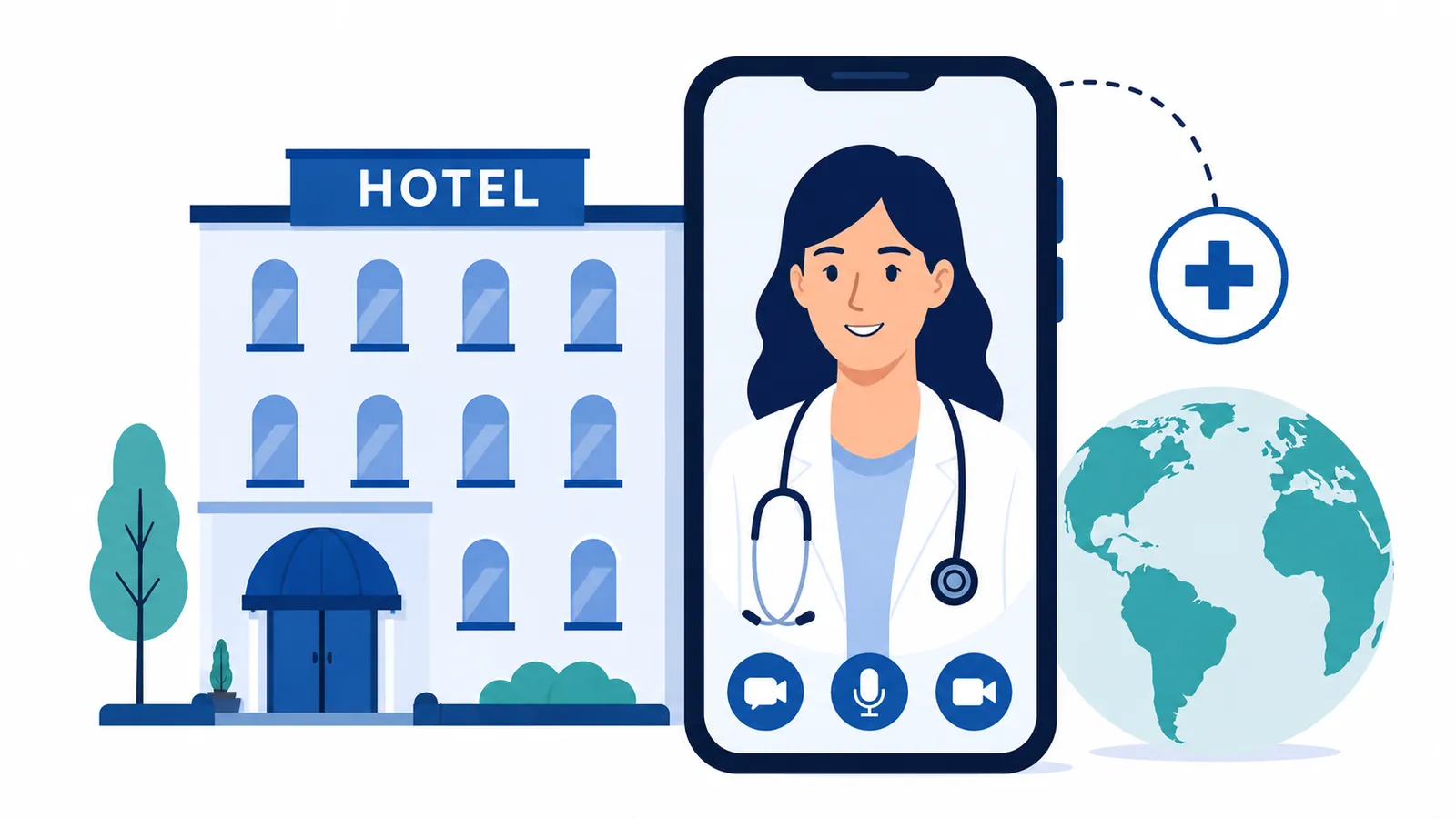
This page helps hotel teams share simple, reliable information when a guest experiences a health problem during their stay.
The establishment's role is to guide the guest towards the appropriate service, without making a diagnosis or unnecessarily collecting medical information.
This page replaces neither medical advice nor the emergency services.
The emergency numbers to know
15 — Emergency medical assistance service (SAMU) For a medical emergency or when a medical assessment and guidance are needed.
112 — European emergency number It reaches the emergency services from France and the other European Union countries.
Calls to 15 and 112 are free and available 24 hours a day from a landline or mobile phone.
When to call?
Call 15 or 112 immediately when the guest reports in particular:
- significant difficulty breathing;
- chest pain;
- loss of consciousness;
- a sudden neurological deficit;
- significant bleeding;
- severe faintness;
- or any situation that appears urgent.
In case of doubt, staff do not have to determine the seriousness of the situation themselves. They can call 15 and simply describe the facts observed or reported. The dispatch service will indicate what to do.
Understanding an international traveller's expectations
A foreign guest may be used to a healthcare system very different from the French one. The difficulties often come less from the medical problem itself than from the lack of familiar reference points.
"I want a doctor to come to my room"
In some countries, a private doctor's visit to the hotel is a common service.
In France, medical visits may exist depending on the city, the time and the professionals available, but they are not guaranteed and may require a delay.
The useful response is simply to explain the available options:
- calling 15 or 112 in an emergency;
- a doctor at a practice;
- an on-call medical service;
- a medical visit when it is available;
- a teleconsultation from the room;
- a pharmacy for a minor need or initial advice.
"I'll go straight to the emergency room"
Hospital emergency services handle urgent or potentially serious situations.
For a situation that does not appear urgent, 15 can help determine the appropriate guidance. The guest may also be directed to a doctor, an on-call facility, a teleconsultation or a pharmacy, depending on their need and local availability.
"I want to buy my usual medicine"
In France, some medicines are available without a prescription, while others require a medical prescription.
The pharmacist can advise the guest, check whether the requested product is available without a prescription and tell them whether medical advice is needed.
"Will my insurance reimburse me?"
Reimbursement terms depend on the guest's travel insurance contract.
It is best to invite them to:
- check the terms of their contract;
- contact their assistance service when required;
- keep the consultation receipts;
- keep the pharmacy invoices;
- keep any prescription and any medical document provided by the professional.
Guiding the guest in three steps
1. Could the situation be an emergency?
In case of a worrying symptom or doubt:
call 15 or 112.
The hotel team must neither diagnose the situation nor decide on its own that it is not serious.
2. Does the guest want to talk to a doctor with no identified emergency?
Several options may be offered, depending on the city, the time and availability:
Doctor at a practice A consultation may be sought with a general practitioner or a health centre nearby.
On-call doctor or facility Arrangements provide continuity of care outside usual hours. Their organisation varies by area.
Teleconsultation The guest speaks with a doctor by video from their phone, tablet or computer, subject to real-time medical availability.
This option can be particularly useful:
- when the guest prefers to stay in their room;
- when they are unfamiliar with local medical services;
- when their ability to travel is limited;
- when a consultation in the patient's language is sought, subject to the real-time availability of a doctor able to consult in that language.
Medical visit A visit to the hotel may be sought when a local service offers it and a doctor is available.
3. Does the guest only want a product or pharmaceutical advice?
The pharmacy can be a suitable first option for:
- a first-aid need;
- a common hygiene or health product;
- a minor symptom;
- a question about a medicine;
- finding an on-call pharmacy.
The ways to access on-call pharmacies vary by city and time. Information may in particular be displayed in the window of a closed pharmacy or obtained from the relevant local services.
In all cases:
staff share information and facilitate guidance; they do not give medical advice.
Pharmacy and prescription: the practical points
Medicines without a prescription
Many medicines and health products are available without a prescription.
The pharmacist determines what can be dispensed and advises the guest according to their request. They may also recommend medical advice.
Medicines requiring a prescription
Some medicines can only be dispensed on presentation of a valid prescription.
A prescription issued by a doctor practising in France, including following a teleconsultation when the doctor decides to prescribe, may be presented at a French pharmacy.
Dispensing remains subject to:
- the validity of the prescription;
- the rules applicable to the medicine;
- its availability;
- and the pharmacist's control.
Foreign prescription
A prescription issued in a European Union or European Economic Area country may, under certain conditions, be used in another European country.
Difficulties may nonetheless arise if:
- the medicine has a different name in France;
- the product is not marketed in France;
- the prescription does not contain the necessary information;
- specific rules apply to the medicine.
For a prescription issued outside the European Union or in the case of an interrupted treatment, the guest may seek advice from a pharmacist. Medical advice in France may be necessary.
Travel insurance: the documents to keep
Coverage terms vary with each insurer.
Invite the guest to keep:
- the detailed consultation receipt;
- proof of payment;
- the pharmacy invoices;
- the prescription;
- the contact details of the professional consulted;
- any document provided after the consultation.
The consultation document should ideally specify:
- the date;
- the nature of the service;
- the amount paid;
- the identity or contact details of the professional or facility.
When the contract requires it, the guest must contact their assistance service before incurring certain expenses.
The information the hotel can usefully share
The front desk can give the guest:
- the numbers 15 and 112;
- the address of a nearby pharmacy;
- the known ways to find an on-call pharmacy;
- the contact details of local medical services;
- the teleconsultation options;
- the means of transport to reach a care facility;
- the contact details of their insurance or assistance service, if the guest has them.
The front desk can also help the guest use their own phone or access a link or a QR code.
It must not:
- choose a treatment;
- recommend a specific medicine as a health professional would;
- interpret symptoms;
- guarantee that a situation is not serious;
- intervene in the medical decision or the prescription.
Personal data: limiting the information kept
Symptoms, diagnoses, treatments and health-related information are particularly sensitive personal data.
In practice, the hotel should avoid recording in its tools or registers:
- detailed symptoms;
- a presumed diagnosis;
- treatments followed;
- the name of a medicine;
- the content of an exchange with a doctor;
- a prescription or a medical report.
When the establishment must keep an operational record of an event, it is preferable to limit it to strictly necessary information, for example:
- the time of the request;
- the room number;
- the general nature of the assistance provided;
- "medical contact details shared";
- "call to 15 made";
- "taxi requested at the guest's request".
The establishment's internal procedures must be validated according to its legal obligations, its privacy policy and the recommendations of its data protection officer, where it has one.
Frequently asked questions from hotel teams
A guest asks for a doctor to come to their room immediately. What should we say?
Explain that medical visits to the hotel depend on the services and doctors available locally.
Offer them the options matching the situation:
- calling 15 or 112 in an emergency;
- seeking a medical visit;
- a teleconsultation from their room;
- an on-call doctor or facility;
- a consultation at a practice;
- a pharmacy for a minor request.
It is better to present the possible options rather than only replying that a visit is impossible.
Can we record the guest's symptoms in the hotel register?
It is best not to record symptoms or other detailed medical information.
For operational follow-up, limit the entry to what is strictly necessary, for example:
- "medical contact request";
- "contact details of a service shared";
- "call to 15 made".
The guest speaks neither French nor English. What should we do?
In an emergency, call 15 or 112 and immediately indicate the language the guest speaks. The emergency service will specify the available options.
For a medical request that is not an emergency, prefer where possible:
- a service offering several languages;
- the presence of a companion who can translate;
- a translation tool;
- or a platform whose journey is available in the guest's language.
The DotKtor platform is available in French, English, Spanish, Italian and Portuguese.
The guest can indicate a preferred language. Whether the exchange can take place in that language depends on the doctors available at the time of connection.
Who pays for the consultation?
The guest pays for their consultation directly.
The establishment intervenes neither in the payment nor in the medical relationship.
With DotKtor, the price is shown to the client before any booking.
Should the hotel call the emergency services itself?
When the situation appears urgent, when the guest cannot call themselves, or when serious doubt exists, the team may call 15 or 112 and pass on the factual information available.
The emergency service then indicates what to do.
Does the hotel incur liability by guiding a guest?
The establishment may pass on factual information about the available services and help the guest contact them.
To limit risks, teams should in particular:
- not make a diagnosis;
- not promise a medical outcome;
- not downplay a worrying symptom;
- call the emergency services in case of doubt;
- not keep health data unnecessarily;
- follow the establishment's internal procedures.
This page is general information and does not replace legal advice tailored to the establishment's situation.
The complete guide for your teams
A more detailed guide is available free of charge in your establishment's Institution space.
It covers in particular:
- the simple phrasings to use with an unwell guest;
- the right reflexes depending on the situation;
- the limits of the front desk's role;
- the various guidance options;
- the precautions concerning medical information and personal data;
- the information useful to international travellers.
Back to "Video teleconsultation for your international guests"
Medical emergency
In an emergency or if in doubt about the seriousness of the situation, call 15 or 112.